Glimbora Insights
Olive Young’s American Debut and the Road to Canada

“People camped out on a Pasadena sidewalk overnight. For a skincare store.”
Yesterday, May 29, Olive Young opened its first American store in Pasadena, and the line formed the night before the doors did. Korea’s biggest beauty retailer, with more than 1,300 stores at home, chose to arrive in North America not as a counter inside someone else’s banner but as a destination of its own, stocked with about 400 brands. A second location at Westfield Century City is already announced for June. And one day earlier, trade figures confirmed Korea had passed the United States to become the world’s number 2 cosmetics exporter for 2025. Two headlines in 48 hours, one message: K beauty no longer rents space in Western retail. It is opening the doors itself.
This is a momentum case study, and we are reading it the way a Canadian retail buyer should: not as an American story, but as a preview. Below we walk through what a flagship changes that a shelf placement cannot, why the demand curve behind it crosses the border faster than any lease, and the concrete moves worth making before the next two quarters play out, from supply allocation to labelling to launch timing. The store is in California. The opportunity it confirms sits on Canadian shelves.
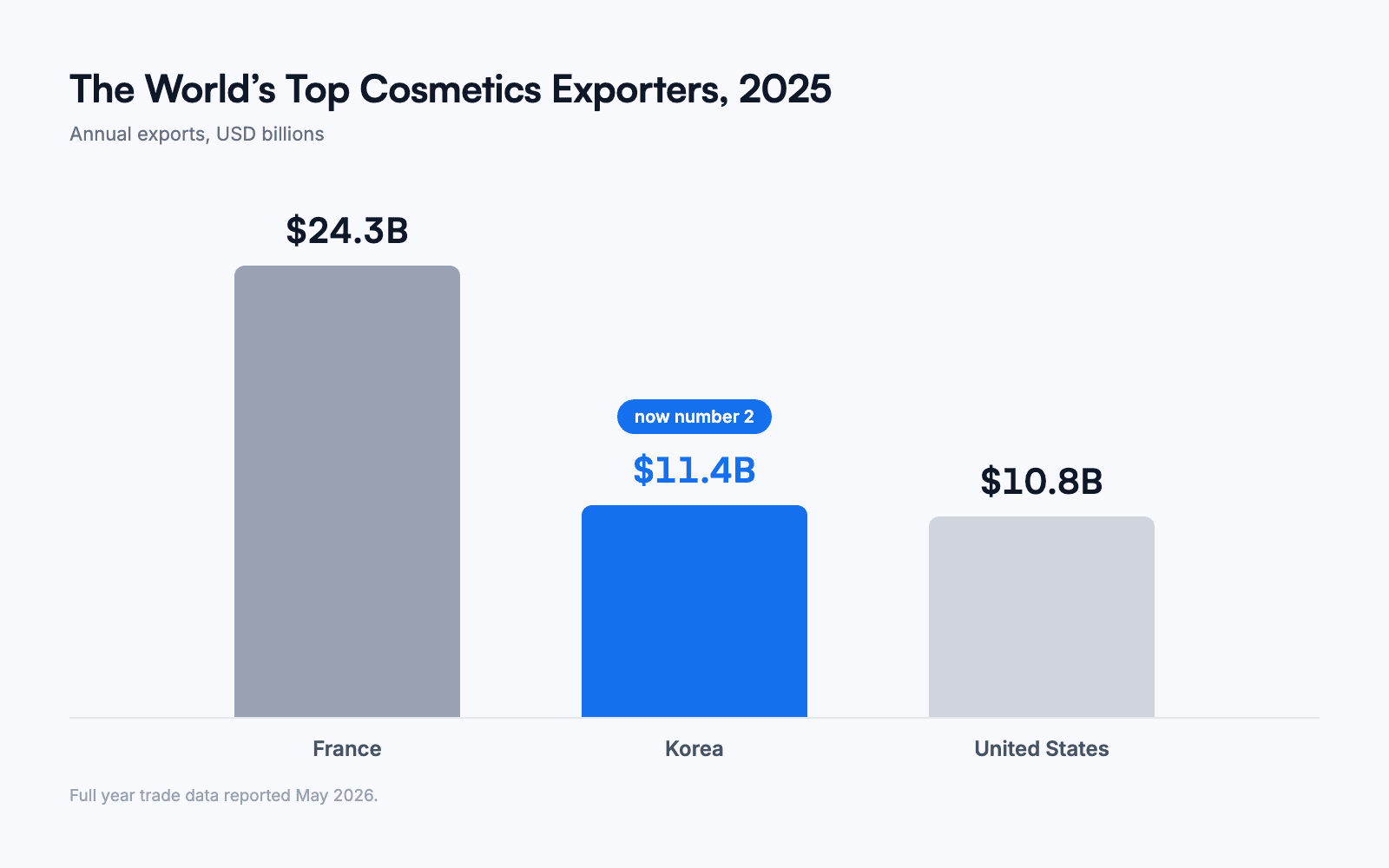
Insight: Korea exported $11.4 billion of cosmetics in 2025, passing the United States at $10.8 billion and trailing only France. Confirmation landed on May 28, one day before Olive Young’s doors opened.
—
What Pasadena Actually Signals
American retail spent 2025 racing to add Korean brands. Sephora launched Biodance in February and kept adding names like Beauty of Joseon and Aestura through the year. Ulta went further, debuting its K Beauty World platform nationwide on July 14 and adding 13 Korean brands over the summer, including TirTir and Mixsoon, after seeding the strategy with Anua back in February. We wrote about what Ulta’s K beauty push signals when it launched: mass American retail had stopped testing the category and started building infrastructure for it.
Pasadena is the next rung up. A shelf placement gives a brand distribution; a flagship gives the retailer control. Olive Young curates its own assortment, sets its own pricing, runs its own trend cycle, and trains its own floor staff, all backed by the merchandising engine it spent two decades honing at home. That is a bigger statement than any single brand launch, because it bets that K beauty is no longer a trend living inside Western beauty retail. It is a retail format of its own, confident enough to sign an American lease under its own name.
The demand data says the flagship will not be lonely. The US overtook China as the top market for Korean cosmetics in 2025 at $2.2 billion against $2 billion, the anchor of a record $11.43 billion export year, up 12.3%, spread across 202 countries. Q1 2026 then set another quarterly record at $3.1 billion, up about 19%. When the category leader opens a store into that curve, attention compounds.
—
The Road to Canada Is Shorter Than It Looks
Olive Young has not announced a Canadian store, and it does not need one for the effect to arrive here. Pasadena content is already filling the feeds Canadian shoppers scroll, and the Canadian beauty landscape is unusually receptive to it. Sephora Canada is on track to pass 160 stores this spring, up from 132 a year ago, while the liquidation of Hudson’s Bay last year left a large pool of department store beauty spending looking for a new home; we traced where those shoppers went when the doors closed. Demand will cross the border months before any lease does, and retailers who wait for a domestic headline will be buying against American allocation already spoken for.
The border math sharpens the case. Korean cosmetics have entered Canada duty free under the Canada Korea Free Trade Agreement since 2015, while every Korean beauty shipment into the US has carried a 15% tariff since last August. Olive Young opened its flagship into a cost headwind. A Canadian retailer stocking the same brands faces none of it, which is a quiet structural edge worth using while it lasts.
Three moves worth making now:
Lock supply early: hero products sell out fastest exactly when a flagship moment spikes the category. Brand headquarters route production runs to the largest purchase orders first, and an American flagship plus two national chains is the largest purchase order there is. Commit before the spike, not during it.
Get labels ready: Health Canada’s new fragrance allergen disclosure rules took effect in April, naming 24 allergens that must now appear on labels, with a second, longer list arriving in August for new products. Stock prepared for both deadlines clears shelves and audits without drama.
Build the story: shoppers arriving from Pasadena headlines want curation and education, not just product on a shelf. A trained staff pick, a simple routine story, and a small discovery section convert borrowed attention into repeat baskets.
Key takeaway: Korean cosmetics enter Canada duty free under the Canada Korea Free Trade Agreement, while every shipment into the US now carries a 15% tariff. The border math quietly favours Canadian shelves.
—
Get There Before the Line Forms
Pasadena drew an overnight line because the demand existed years before the store did. Canada sits in the same position today, and the practical question is what to do with the head start. Here is how we would spend the next 90 days running a Canadian beauty shelf:
Audit the assortment: count your Korean skincare facings against your total skincare wall. If the category that just produced the world’s number 2 exporter occupies one corner shelf, the gap between what your shoppers watch and what they can buy from you is the whole opportunity.
Ask where the stock sits: inventory already cleared, labelled, and warehoused in Canada is insulated from the allocation pressure a US flagship moment creates. A supplier quoting from a Korean warehouse is quoting a hope; a supplier quoting from a Canadian one is quoting a delivery date.
Time the launch to the attention: the second Olive Young store opens in June, and every opening will refill the feeds. Plan endcaps, staff briefings, and social posts for the weeks the category is already in your customers’ pockets.
This is the work we do year round as a Vancouver based distributor of Korean cosmetics. We carry 17 brands and about 390 catalogued products, including Skin1004, Numbuzin, Mixsoon, Dinto, and Muzigae Mansion, with regulatory intake, labelling, import clearance, and warehousing handled before a retailer ever places an order; the wholesale catalogue shows the current depth. And we have walked this curve before: Eqqualberry, a brand we distribute, now sits in eight H Mart locations across Metro Vancouver and Alberta.
—
What Canadian Buyers Are Asking
Will Olive Young open a store in Canada?
Nothing is announced. The sequence so far, Pasadena first and Westfield Century City weeks later, reads like a plan to build density in one American region before crossing any border. The useful planning assumption for a Canadian buyer is that the demand arrives without the store, because it already is arriving, through feeds, search, and cross border shopping trips.
Does the US flagship make it harder for Canadian stores to get Korean brands?
It tightens allocation on hero products. Brand headquarters route production to the biggest purchase orders, and a flagship moment layered on national chains creates very big orders. The counter is simple: buy from inventory that already sits in Canada, so next month’s allocation call in Seoul is not your problem.
Should I wait for more proof before committing shelf space?
The proof already printed. Korea exported a record $11.43 billion in 2025, the US overtook China as its top market, and the number 2 exporter ranking was confirmed on May 28. Retailers who moved before Ulta’s rollout chose their terms; retailers who moved after competed for what remained.
Which categories should a first order lean into?
Skincare heroes carry the momentum: cica and centella lines, essence and serum staples, and sun care, with a small colour story such as lip tint to catch the impulse buyer. Start narrow, read your sell through weekly, and deepen what moves rather than spreading a first order thin.
The line in Pasadena formed overnight, but it was years in the making. The Canadian version is forming now, in feeds and search bars instead of on sidewalks. The retailers who stock the shelf before that attention reaches the till will own the category in their neighbourhood, the same way Olive Young now owns a block of Pasadena.
Ready to stock the shelves shoppers will line up for?
Let’s talk.
Glimbora Insights