Glimbora Insights
New Fragrance Allergen Rules for Cosmetics in Canada
“Parfum” just stopped being the whole story on Canadian cosmetic labels.
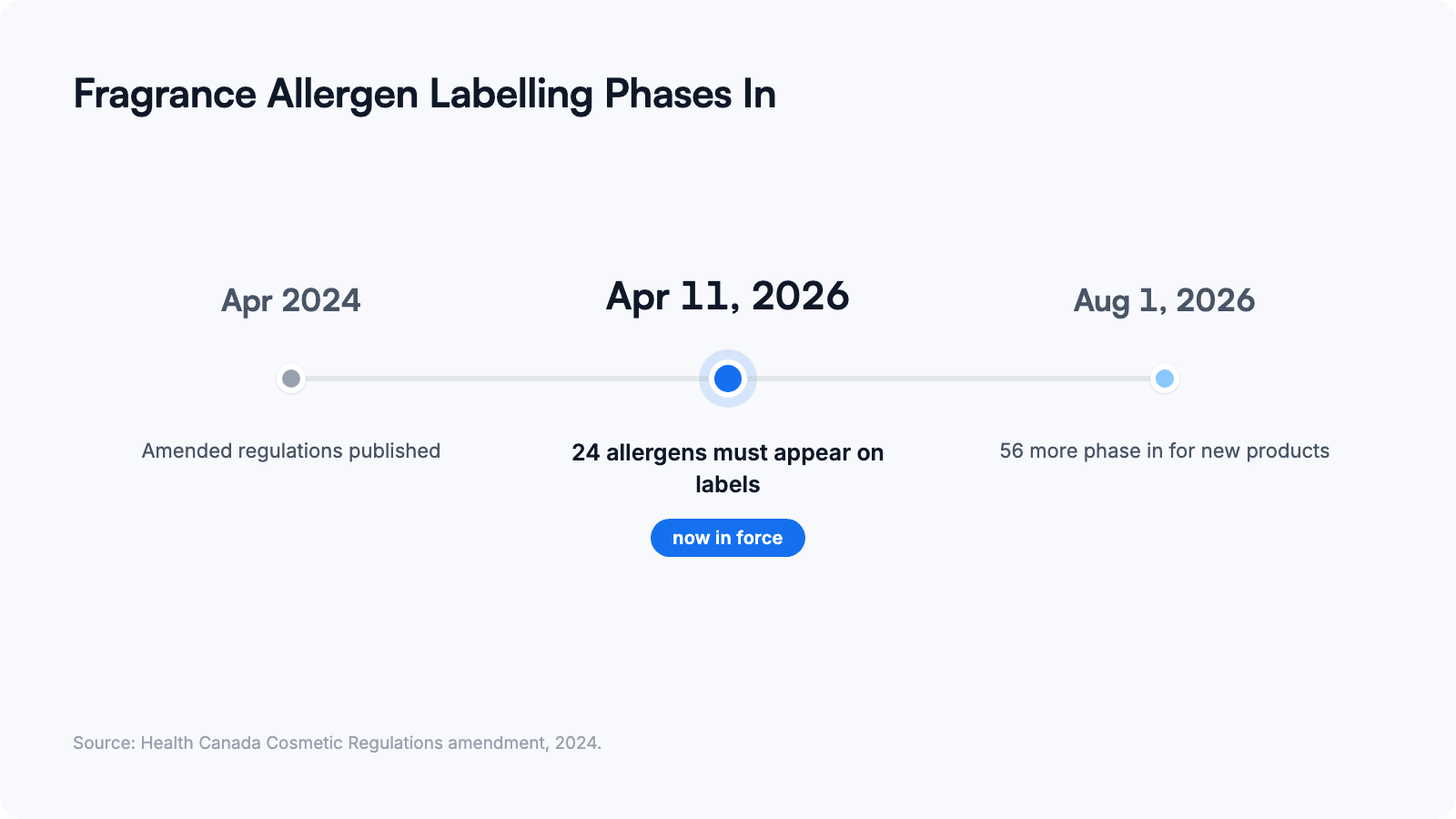
As of April 12, 2026, Health Canada’s amended Cosmetic Regulations require 24 fragrance allergens to be named individually in the ingredient list of every cosmetic sold in Canada. The change has been public since April 2024, and it sits on top of the bilingual labelling requirements for cosmetics in Canada that buyers already know. A further 56 allergens phase in from August 1, 2026 for newly introduced products. If you buy for a beauty retailer, a pharmacy, or a grocery banner, the question this month is simple: does the stock on your shelf, and the stock on the water, carry the right label?
This guide covers what changed, how to audit current inventory and incoming purchase orders, how the new allergen lines fit into the bilingual label Canadians already read, and who actually owns the fix when a label falls short. None of it needs a law degree. Most of it needs a magnifying glass and a supplier who answers email.
Insight: Disclosure kicks in at just 0.001% for products that stay on the skin and 0.01% for products you rinse away, so even trace amounts of the 24 listed allergens now belong on the label.
—
What Retail Buyers Should Check Right Now
The rule applies to what is offered for sale, not only to what is newly imported. That single sentence sets your priorities: the audit starts on your own shelf, then moves to the purchase orders behind it. Four checks cover most of the risk:
Ingredient lists: a fragranced product should now name allergens such as limonene, linalool, citral, or geraniol alongside “parfum,” not bury them inside it. All four sit on Health Canada’s first list of 24, and they show up in everything from citrus toners to floral creams.
Incoming purchase orders: confirm with every supplier that cartons arriving after April 12, 2026 carry updated artwork or compliant overlay labels. Get that answer in writing before the container leaves port, not after it lands.
New listings: products first introduced from August 1, 2026 must disclose the expanded list of 56 additional allergens, so ask new brands which version of the label they printed.
Your own product pages: if your webstore publishes ingredient lists, sync them with the new panels so a shopper never sees two different lists for the same jar.
Here is what compliant looks like in practice. An older label on a scented cream reads “aqua, glycerin, parfum.” The updated panel reads “aqua, glycerin, parfum, limonene, linalool” because those two allergens sit above the disclosure threshold. Same formula, same jar, one honest line longer.
A workable audit takes an afternoon: pull your fragranced SKUs, photograph every ingredient panel, flag anything that shows “parfum” with no allergen names, and send the list to your suppliers with a reply deadline. None of this requires a lab. It requires someone who reads labels for a living.
—
Bilingual Labelling Requirements for Cosmetics in Canada: The Baseline
Nothing about the allergen rule replaces the basics.
The bilingual baseline
Cosmetics sold in Canada still carry mandatory information in both English and French: the product identity, directions, and any warnings read in both languages, while the ingredient list is written in INCI nomenclature, the international naming system Canada shares with the EU. That structure is the quiet good news of this change. The new allergen names are themselves INCI terms, so limonene reads as limonene in Montreal and in Vancouver, and a compliant label stays one label. Nothing needs translating. It needs printing.
Why Korean stock adapts fast
Most Korean manufacturers already print allergen disclosures on the export versions they ship to Europe, where the practice has been mandatory for two decades. Health Canada deliberately aligned its list with the EU’s, which is why a factory in Seoul treats the Canadian update as an artwork revision, not a reformulation. And since Korean cosmetics enter Canada duty free under the free trade agreement, the label really is the last gate between the factory and your shelf.
Where the gap actually sits
The gap for Canada is usually not the formula. It is the artwork: French text, Canadian claims, and now the allergen lines, all verified batch by batch before a carton reaches a store. A brand can pass in March and fail in May if a fragrance house adjusts a blend and nobody rechecks the panel, which is why verification belongs in the reorder cycle, not only at onboarding.
Key takeaway: Health Canada built its allergen list to match rules the EU has enforced since 2005, which is why most export ready Korean labels were already halfway to compliance.
—
Who Owns the Fix When a Label Falls Short
Canadian cosmetic compliance follows the importer of record. Buy directly from a brand in Seoul and you are that importer: the bilingual label, the allergen verification, and the notification paperwork all follow you home, the same way the Cosmetic Notification Form does. Buy from a Canadian distributor and those duties land on the distributor’s desk instead of yours. Either way, the pallet in quarantine sits in your supply chain, so the smart move is to know who owns the label before you sign the purchase order.
Three edge cases come up in almost every buyer conversation:
Grey market stock: parallel imported product usually wears the Korean domestic label, which was never written for Canada: no French, no allergen lines, and nobody accountable for fixing either. The allergen rule just made the real cost of grey market Korean cosmetics visible at a glance.
“Unscented” products: a masking fragrance can still contain listed allergens, and the thresholds care about concentration, not marketing language. Ask the supplier for fragrance documentation rather than trusting the front of the jar.
The long runway: products already on the market have until August 1, 2028 before the expanded allergen list applies to everything sold in Canada, so the same SKU can legitimately arrive with two different label versions during the transition. Keep purchase orders traceable to label versions and the overlap never becomes a problem.
None of these edge cases is a reason to shrink the fragrance wall. They are a reason to buy through someone who tracks them.
—
What Buyers Are Asking This April
Do products already on my shelf need new labels?
Yes. Compliance is judged on everything offered for sale, not just on freshly imported stock. Audit your fragranced SKUs now, and ask suppliers for updated artwork or compliant overlay labels on anything that names only “parfum.”
Did the bilingual labelling requirements for cosmetics in Canada change too?
No. English and French mandatory information stays exactly as it was, and the ingredient list stays in INCI. The allergen names are INCI terms themselves, so they slot into the existing list without translation.
What changes on August 1, 2026?
Newly introduced products must disclose 56 additional allergens beyond the first 24. If you are onboarding a new brand this summer, ask which version of the label it printed before you commit shelf space.
Is this a reason to buy less fragranced K beauty?
No. Korean factories have printed EU style allergen disclosures for two decades, and Korean cosmetics exports just posted a record $3.1 billion first quarter, up 19%. The category is accelerating. The label simply has to keep up.
As a Vancouver based distributor, we treat labelling as part of the product, not an afterthought. Regulatory intake, bilingual artwork checks, and allergen verification happen before inventory ships, across 17 brands and about 390 catalogued products in our wholesale catalogue, so our partners never quarantine a pallet over a missing word of French.
Ready to stock K beauty that clears the fine print before it clears the port?
Let’s talk.
Glimbora Insights