Glimbora Insights
Margin Math for Korean Skincare in Canadian Stores
“A beautiful product at the wrong margin is just expensive shelf decoration.”
Canadian buyers ask us the same question in almost every first meeting: what does a Korean skincare retail margin actually look like once the pallet reaches my stockroom? It deserves a better answer than a vague slide about healthy category economics. So here is the math, piece by piece: how the industry structures markup, what really sits inside landed cost, how promotions behave once the season starts, and why the calendar matters as much as the calculator. Demand is not the question anymore. September was the biggest export month Korean cosmetics have ever recorded, and Canadian shoppers already know the brands by name. The real question is whether the economics of your shelf are built properly from day one, because everything that follows, pricing, promotion, reorder cadence, even how many facings you give a hero serum, flows from the margin structure you lock in before the first unit sells.
September 2025 was the biggest single month in Korean cosmetics export history: about $1.15 billion shipped, up roughly 26% year over year.
—
Keystone, Keystone Plus, and What the Convention Hides
Beauty retail still runs on a simple convention. Keystone means the ticket price doubles the wholesale cost, a 50% gross margin. Keystone plus means anything above that, and strong specialty retailers treat it as the target, not the ceiling. One definition worth pinning down before any negotiation: margin and markup are not the same number. Margin is profit as a share of the ticket; markup is profit as a share of cost. Keystone is a 50% margin and a 100% markup at the same time, and a buyer who asks for “60 points” is asking for a ticket of 2.5 times cost. Knowing which language your counterpart is speaking saves real money at the table.
Here is where Korean skincare gets interesting. The formulas and packaging read as prestige, yet wholesale costs typically sit well below comparable western prestige lines. That gap does two jobs at once:
Room to price with confidence: a keystone plus ticket can still land under the western product one shelf over.
Room to promote without pain: a holiday discount comes out of cushion, not out of bone.
A worked example
Take a serum at a wholesale cost of $12. Keystone puts the ticket at $24. Price it at $29, still comfortably under the western prestige serum one shelf over, and the margin climbs to about 58.6%. Now run a 20% holiday promotion: the ticket drops to $23.20 and the margin lands near 48.3%, essentially keystone on a discounted price. That is the whole story of this category in one arithmetic exercise. The structure lets you promote hard in season and still bank the margin most categories only see at full price.
We will not print fantasy percentages; your exact number depends on brand, format, and volume. The structure, though, is consistent, and it is friendlier than most categories on your floor.
—
Landed Cost, the Number Under the Number
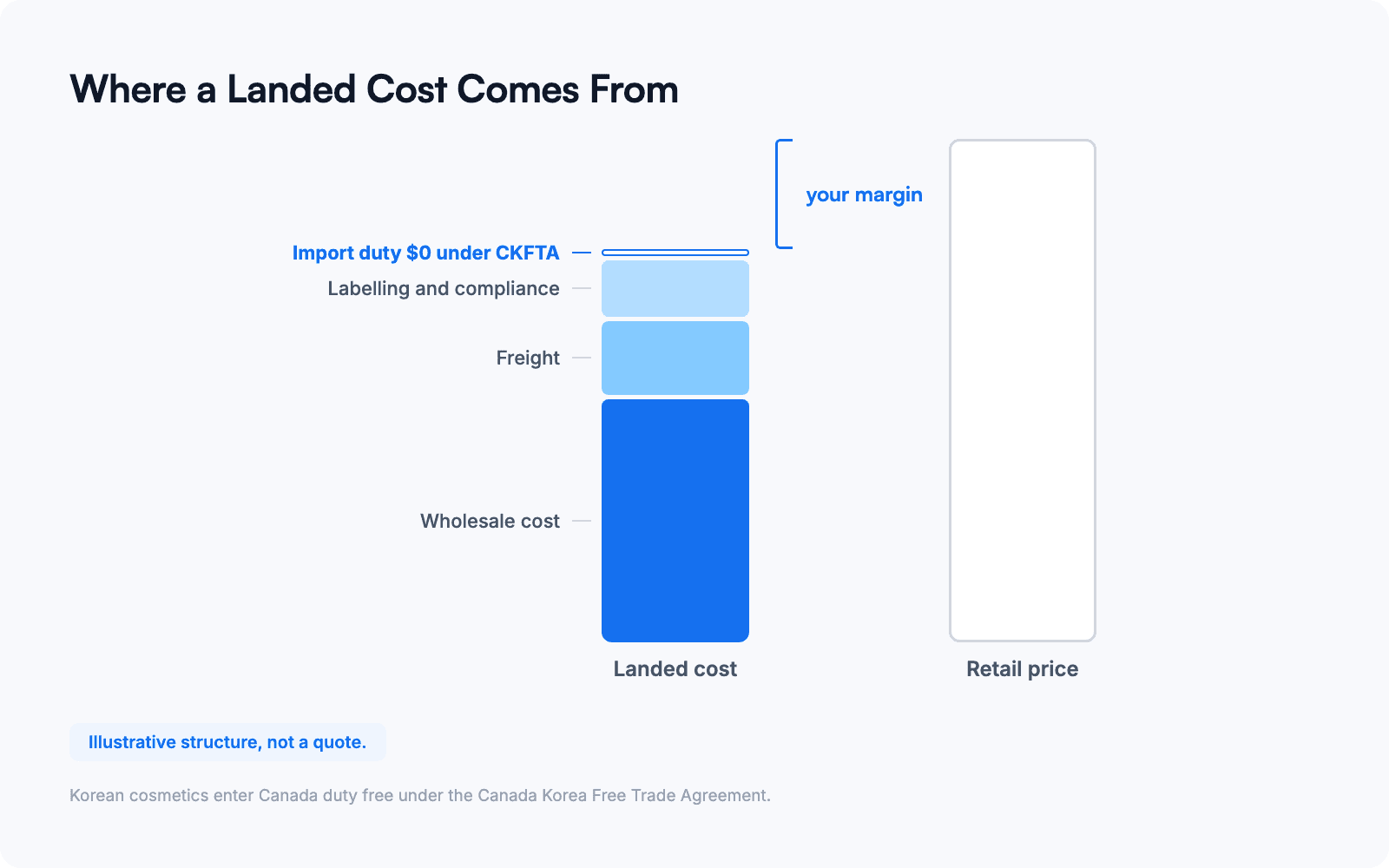
Margin is only as real as the landed cost beneath it. Four lines decide it:
Freight: ocean from Busan to Vancouver is measured in weeks and pennies per unit; air is measured in days and dollars. Timing decides which one you pay for.
Duty: Korean cosmetics enter Canada duty free under the Canada Korea Free Trade Agreement, in force since 2015. The zero is earned by paperwork: each shipment needs a valid certificate of origin, and without one the same pallet clears at Canada’s regular 6.5% rate for beauty preparations.
Labelling and compliance: bilingual labels, proper ingredient listings, and the Cosmetic Notification Form every product needs before it sells in Canada are costs someone absorbs before the first unit moves. Budget them once, properly, or pay them twice in relabelling.
Currency: Korean suppliers quote in won or American dollars while your shelf sells in Canadian dollars, and exchange movement between order and arrival can quietly shave a point of margin. Lock your Canadian dollar cost at the quote, not at the invoice.
How to compare two quotes properly
Never weigh a bare FOB price, the cost of goods before anything crosses an ocean, against a landed one. Ask every supplier the same question: what is my all in cost per unit delivered to my stockroom, with freight, clearance, labelling, and notification inside it? The quote that looks cheaper on the first line often finishes more expensive by the last one, and the gap only shows up after you have committed the order.
The calendar is part of the math
Black Friday lands on November 28. Ocean freight booked now, in the middle of October, arrives with time to build displays; anything ordered later flies, and air freight quietly eats the cushion you just built. With rotating postal disruptions rolling across Canada this fall, more holiday beauty gifting will happen in store, so stock the shelf, not the excuse.
Key takeaway: The duty line on Korean skincare is zero. Under CKFTA, every dollar that would have gone to tariffs stays in the margin conversation between you and your distributor.
—
Defending Your Korean Skincare Retail Margin in Season
The margin on the price sheet is a plan. The margin in your year end statement is what survived promotions, markdowns, testers, and slow movers. Protecting that number after launch comes down to a few habits:
Watch sell through, not sales: units sold divided by units received tells you whether a SKU earns its facing. A serum can post good dollars and still be overbought. Review the rate weekly in season and let reorders follow it, not the gut.
Promote on a calendar, not on panic: planned promotions come out of the cushion built above keystone; unplanned clearance comes out of bone. Decide in October which lines carry the Black Friday discount and hold the rest at full price.
Treat testers as marketing, not shrink: a tester on every facing is the cheapest conversion tool in beauty retail. Build it into the buy so it never reads as lost margin later.
Mind price integrity: a shopper who finds the same product wildly cheaper from an unauthorized online seller learns to distrust your ticket. Buying through an authorized channel keeps your pricing defensible and your supply traceable.
The number that ties it together
If you track one metric beyond margin, make it GMROI: gross margin dollars earned per dollar of inventory held. Korean skincare tends to perform well here because wholesale costs are modest and replenishment is steady, but only when the shelf is worked. Display, education, and adjacency decide velocity, and velocity decides GMROI, which is why we treat merchandising Korean beauty properly as part of the margin conversation, not a separate one.
—
Margin Questions Canadian Buyers Ask
Is keystone realistic for Korean skincare in Canada?
Yes, and keystone plus is common. Wholesale costs sit well below comparable western prestige lines while shoppers read the products as premium, so the spread supports a 50% margin with room above it. Your exact number depends on brand, format, and volume, which is why we quote per assortment instead of publishing a blanket figure.
Does the duty free treatment really change the math?
Materially. Zero duty under CKFTA versus the regular 6.5% rate is margin that never leaves the room, and it compounds across every reorder. It is also a structural reason a Korean skincare retail margin in Canada can outrun the same shelf in the United States, where the same products have carried a 15% tariff since August 7.
What eats margin most often in the first year?
Air freight from late ordering, relabelling because compliance was an afterthought, and unplanned clearance on overbought SKUs. All three are calendar problems before they are cost problems, and all three disappear when the boring parts are owned early.
When is the deadline for holiday inventory?
For ocean freight, effectively now. Orders placed in the middle of October sail from Busan with time to build displays for November 28; after that, the same units travel by air and the difference comes straight out of your cushion.
The best margin stories we see share one trait: the boring parts were finished before the buyer ever saw a price sheet. As a Vancouver based distributor of Korean cosmetics, we quote Canadian retailers one wholesale price with regulatory intake, labelling, import clearance, and warehousing already inside it, across 17 brands and about 390 catalogued products in our wholesale catalogue, so the number on the sheet is the number in your spreadsheet. And if you are still deciding who sits on the other side of that sheet, our guide to choosing a Korean cosmetics wholesale partner covers the questions to ask before the first order.
Ready to build a Korean skincare retail margin worth defending this holiday season?
Let’s talk.
Glimbora Insights