Glimbora Insights
The Real Cost of Grey Market Korean Cosmetics

“The deal of the season is sometimes just a problem wearing a discount sticker.”
Black Friday lands on November 28, and right on schedule, Canadian retail buyers are fielding pitches for Korean skincare at prices that make no sense. Before you wire a deposit, weigh the grey market Korean cosmetics risks hiding behind that quote, because the cheapest carton in your inbox can become the most expensive mistake on your shelf. The timing is no accident. Amazon Haul opened in Canada on November 14, flooding feeds with ultra cheap beauty listings, and rotating postal disruptions have buyers hunting for anyone promising fast, cheap stock. Sellers of diverted goods know exactly when your guard is down.
This guide goes deeper than a warning label. We will define what grey market actually means, walk the specific risks one by one, hand you a verification checklist you can run in an afternoon, and work a real example showing how the cheaper carton becomes the expensive one. If you buy Korean skincare for a Canadian shelf, deal season is exactly when this discipline pays for itself.
Insight: September 2025 was the biggest single month in Korean cosmetics export history at roughly $1.15 billion, up about 26% year over year. Demand that hot always pulls grey market supply in behind it.
—
Grey Market Korean Cosmetics Risks, Line by Line
Grey market stock is genuine product moving outside the channel the brand authorized. It is not counterfeit, which is exactly why it feels safe. The pallet usually starts life legitimately: a wholesaler in another market orders too much, a duty free allocation gets flipped, or an exporter quietly clears cancelled orders. By the time a broker emails you a quote, the goods have changed hands two or three times, and every handoff strips away something the invoice never shows:
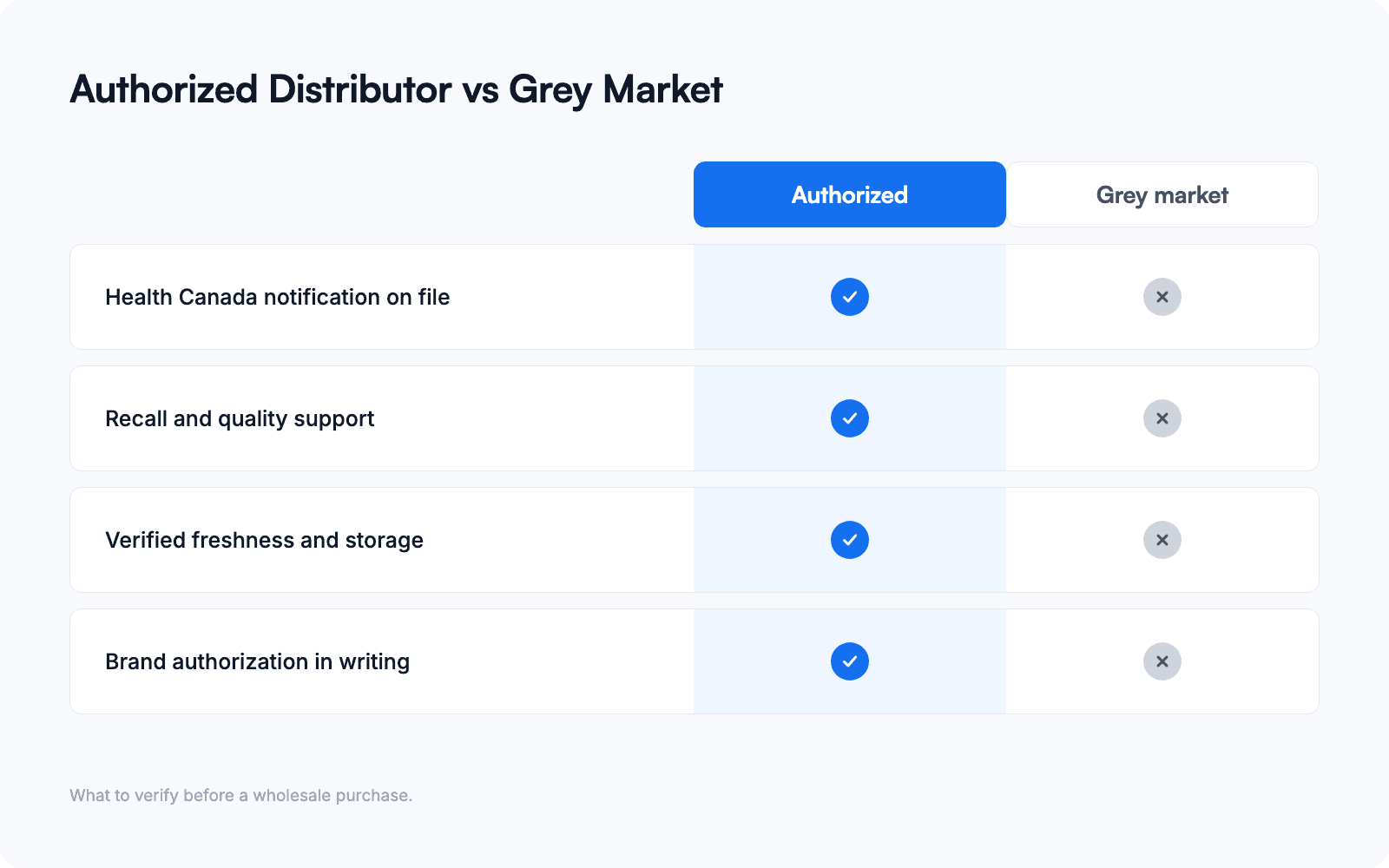
No notification coverage: every cosmetic sold in Canada must be notified to Health Canada within 10 days of first sale. Diverted cartons usually have nothing on file, the exposure lands on whoever put them on the shelf, and “my supplier handled it” is not a defence when nothing exists in the system. Our explainer on the Cosmetic Notification Form shows what proper coverage looks like.
No recall support: when a brand pulls a batch or reformulates, the notice travels through authorized channels. A grey market buyer is invisible to that chain and finds out from customers.
Unknown storage and expiry: that pallet may have crossed three brokers and sat through a summer in a hot container. Essences and ampoules do not forgive heat, and manufacture dates printed only in Korean help no one at your till.
Labelling gaps: Canada requires bilingual English and French labelling with a proper ingredient declaration. Diverted stock arrives in Korean domestic or export packaging, and fixing that after delivery costs money, weeks, and shelf timing you do not have in November.
Brand relationship damage: brands track where their product surfaces, often through the very batch codes grey sellers scratch off. Retailers caught moving diverted stock rarely get the authorized line, the launch exclusives, or the marketing support later.
—
How to Verify an Authorized Supplier
Five minutes of checking beats five months of markdowns. Before any deal season order, run five checks in this order, and stop the moment one fails:
Ask for the paper: a real distributor can show brand authorization, Health Canada notification records, and import entry documents for every SKU on the quote. Stalling on any of the three is your answer.
Check the math: Korean cosmetics enter Canada duty free under the Canada Korea Free Trade Agreement, in force since 2015, so authorized pricing is already sharp. A quote sitting far below every authorized distributor is not a better negotiator; it is a different supply chain.
Call the brand: Korean beauty brands answer distribution inquiries quickly, and most will confirm their official partners by country. If the brand has never heard of your supplier, you have your answer.
Inspect a sample carton: look for batch codes that are intact rather than scratched or stickered over, manufacture and expiry dates you can actually read, bilingual labels already applied, and outer cartons that match the brand’s current packaging. Diverters remove batch codes precisely because brands use them to trace leaks.
Listen for the boring answers: an authorized partner talks comfortably about recall procedure, storage conditions, and replenishment lead times. A trader talks about the price and the deposit deadline. The full criteria live in our guide to choosing a Korean cosmetics wholesale partner in Canada.
Key takeaway: An authorized supplier can produce brand authorization, notification records, and import paperwork on request. A grey market seller can produce a discount. Only one of those protects your shelf in January.
—
Cheap Stock Is the Most Expensive Kind: A Worked Example
Numbers make this argument better than adjectives, so suppose two quotes sit on your desk. An authorized distributor offers a popular serum at $11 per unit. A broker offers what looks like the same serum at $9. On 600 units, the grey pallet appears to save $1,200, and in deal season that feels like found money.
Now walk the pallet to the shelf. The cartons arrive in Korean export packaging, so compliant bilingual labels must be printed and applied by hand; say that costs $0.50 per unit and two weeks you did not plan for. Two weeks matters when Black Friday lands on November 28 and Cyber Monday follows on December 1. Then the dates: a third of the units carry under a year of shelf life, and short dated skincare needs a markdown to move. Take 25% off 200 units at a $22 ticket and $1,100 of planned revenue is gone. Add the $300 of labelling and the saving is underwater before a single customer walks in holding an off smelling essence, and none of this ever appears on the broker’s invoice.
That is the honest arithmetic: grey market pricing looks like margin and behaves like risk. Real margin is built on a landed cost you can see and defend, line by line, which is why we published the full breakdown in our margin math guide for Korean skincare in Canadian stores. When a customer asks where your stock came from, the answer should take one sentence, not a lawyer.
—
Grey Market Questions Canadian Buyers Ask
Is grey market the same as counterfeit?
No. Counterfeit is fake product; grey market is genuine product diverted outside the authorized channel. The legal difference is real, but on your shelf the practical grey market Korean cosmetics risks overlap: no notification, no recall visibility, no storage history, no brand support.
Is selling grey market stock illegal in Canada?
Selling genuine goods is not automatically illegal, but the compliance duties never disappear. Whoever sells a cosmetic in Canada is responsible for Health Canada notification, bilingual labelling, and ingredient compliance. Most diverted stock fails at least one of those tests, and the retailer carries the exposure.
How do I spot a grey market quote before committing?
Three tells: a price far below every authorized distributor, vague answers when you ask for notification and import paperwork, and a brand that cannot confirm the seller as a partner. Any one of them is enough to walk away.
Does a big marketplace listing mean the stock is authorized?
No. Marketplaces host third party sellers, and a polished listing proves nothing about the supply chain behind it. Buy wholesale from a channel the brand itself can name.
Black Friday margin should come from planning, not from mystery pallets. As a Vancouver based distributor, we import our 17 Korean brands directly, from Skin1004 to Eqqualberry, the brand we placed into eight H Mart locations across Metro Vancouver and Alberta. Regulatory intake, labelling, import clearance, and warehousing happen in house before a carton reaches your stockroom, and every one of the roughly 390 products in our wholesale catalogue carries paperwork we can produce on request.
Want deal season margins without the grey market gamble?
Let’s talk.
Glimbora Insights