Glimbora Insights
The Cosmetic Notification Form Explained for Retailers

“Nobody reads the Cosmetic Regulations until a shipment is sitting in a warehouse with a question mark on it.”
Here is the long version, written for the person placing the order rather than the person writing the statute. Every cosmetic sold in this country must be declared to Health Canada, and Canada’s Cosmetic Notification Form requirements decide whether the serum you just bought gets to stay on your shelf. This spring, with buyers across Canada quietly rearranging their sourcing and Korean cosmetics coming off a record $2.6 billion export quarter, plenty of stores are ordering Korean product for the first time.
So this guide walks through the whole thing: what the form is, what goes on it, who owes it, the deadlines that matter, what happens when nobody filed, and the questions worth asking a supplier before the next purchase order goes out. None of it requires a lawyer. All of it requires an owner.
Key takeaway: The Cosmetic Notification Form is due within 10 days after a product’s first sale in Canada, and filing it is free. Late is common; unfixable is rare; unnoticed is the expensive one.
—
What Canada’s Cosmetic Notification Form Requirements Actually Cover
The Cosmetic Notification Form, or CNF, is a declaration filed with Health Canada for every cosmetic sold in Canada. Three things surprise buyers the first time they meet one:
It is a notification, not an approval: Health Canada does not license cosmetics in advance. The form simply tells the regulator the product exists and what is in it.
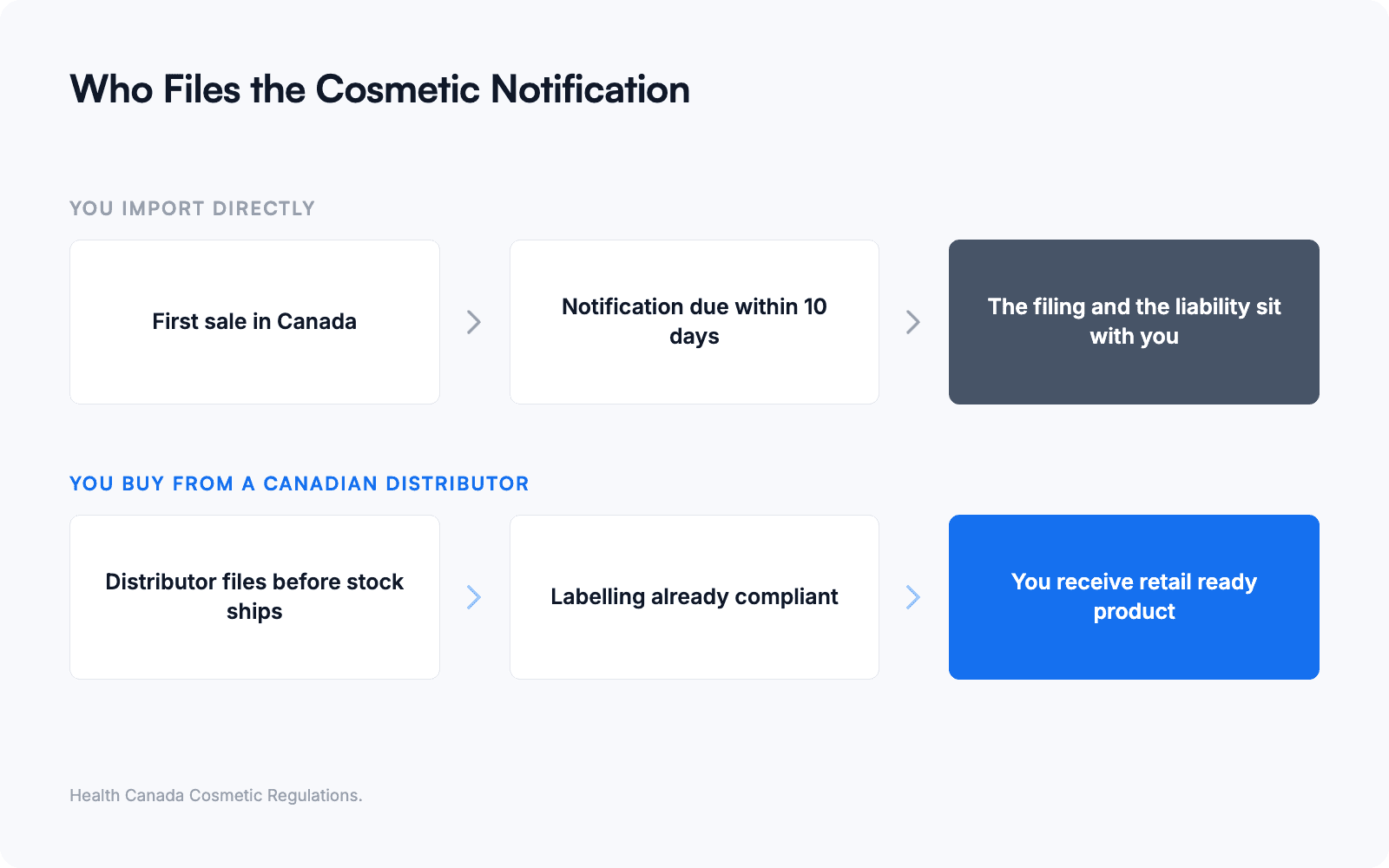
The clock is short: the filing is due within 10 days after the product is first sold in Canada. Not before launch, not “eventually.”
It is not the retailer’s form: the duty sits with the manufacturer or the importer, the party that brought the product into the country.
What actually goes on the form
The CNF captures the product’s brand and name, its function, its format, the name and address of the manufacturer and the importer, and every ingredient by its INCI name with an exact concentration or a concentration range. That ingredient grid is the working heart of the document. It is how Health Canada screens a formula against the Cosmetic Ingredient Hotlist, the published list of prohibited and restricted ingredients. Prohibited entries cannot appear at all. Restricted entries may be used only under conditions such as a concentration cap, a limited product format, or a mandatory caution statement on the label. When a notified formula trips a Hotlist entry, Health Canada writes to the notifier, and the product gets reformulated, relabelled, or pulled.
The filing is never quite finished
Once a product is notified, Health Canada issues a cosmetic number that follows the product for life. Change the formula, the product name, or the responsible company’s contact details, and an amended notification is due within 10 days of the change. Discontinue the product, and that gets filed too. A supplier who treats the CNF as a one time chore rather than a living record is telling you something about the rest of their paperwork.
—
When the Filing Never Happened
Suppose a supplier shipped you a lovely Korean toner and never notified anyone. That product is formally offside. Health Canada can ask for it to be pulled from sale, and the next shipment can be held at the border. You did nothing wrong, yet your shelf and your reorder both stall.
The failure mode is rarely dramatic
Nobody raids a boutique over a missing form. The real cost is time: a compliance letter, a paused reorder, a shipment waiting at the border while the paperwork catches up, and an empty peg through your best sell through weeks. The products most likely to be offside are exactly the ones bought through informal channels: parcels forwarded from Seoul, marketplace lots with no named importer, a friend of a friend with warehouse access. Cheap on the invoice, expensive on the shelf.
Who carries the risk depends on how you buy
Order directly from a brand in Seoul and you become the importer, which means the notification duty, the bilingual label, and the ingredient review all follow you home. Buy from a Canadian distributor and the distributor is the importer of record, so the obligation lands on our desk instead of yours. As a Vancouver based distributor, we file and track a CNF for every product we bring in, across 17 brands and roughly 390 catalogued products, before a single carton reaches a store. That sequencing is why Eqqualberry’s launch into eight H Mart locations across Metro Vancouver and Alberta began with notifications and labelling, long before anyone talked about shelf placement.
Insight: Under the Canada Korea Free Trade Agreement, Korean cosmetics have entered Canada duty free since 2015, which makes the CNF, not the tariff table, the real gate between Seoul and your shelf.
—
The Edge Cases Buyers Actually Hit
The basic rule is simple. The exceptions are where orders go sideways. Three are worth knowing before you build a K beauty assortment:
Sunscreens are not cosmetics: in Canada, an SPF claim moves a product into the drug side of the rulebook. Mineral filter sunscreens need a Natural Product Number, chemical filter sunscreens need a Drug Identification Number, and a CNF covers neither. A Korean sun cushion cannot enter the market on a cosmetic filing alone.
Claims can reclassify a product: a toner is a cosmetic; a toner that promises to treat acne is making a drug claim. The words on the carton, not the formula alone, decide which regime applies, which is why translated Korean marketing copy needs a careful read before it is reprinted for Canada.
The label has its own rules: the CNF does not replace labelling. Cosmetics sold in Canada have needed a full INCI ingredient list on the outer label since 2006, alongside bilingual English and French mandatory text. Retail ready means the filing and the label are both done.
Four questions before the purchase order
You do not need to audit anyone. You need four answers in writing:
Notification status: has every SKU on this order been notified to Health Canada, and will you confirm that?
Importer of record: who brought this stock into Canada, and does the notification name them?
Labels: do cartons arrive bilingual with INCI lists applied, or is that left for my back room?
Claims: has the English copy been checked against the drug line, especially on SPF and acne products?
A supplier who answers all four in one email is a partner. A supplier who dodges is a risk transfer. The same test sits at the top of our guide to choosing a Korean cosmetics wholesale partner in Canada, and it filters the field quickly.
—
Cosmetic Notification Form FAQ for Retail Buyers
Does a retailer have to file the Cosmetic Notification Form?
Almost never. Cosmetic notification form requirements in Canada sit with the manufacturer or the importer. Buy from a Canadian distributor and the duty is theirs. Import directly from Korea and it becomes yours, along with the labelling and the ingredient review.
Is a notified product an approved product?
No. The CNF is a declaration, not a licence. Health Canada does not approve cosmetics in advance, and it can still question a formula or order a product off the market after the form is filed. Notification is the floor, not a seal of quality.
What does filing cost?
Nothing. There is no government fee for a CNF or for an amendment. The only real deadlines are the 10 days after first sale and the 10 days after any change. The cost of skipping it is paid later, in stalled shipments and pulled stock.
How do I check that a supplier actually filed?
Ask for the cosmetic number Health Canada issued for the product, or a written confirmation of the submission. A distributor who files their own notifications can produce either in minutes. A reseller forwarding parcels usually cannot, and that silence is your answer.
A good compliance story is an uneventful one: the form filed on time, the ingredients screened before the purchase order, the reorder arriving without drama. That is the honest argument for buying K beauty through a Canadian distributor rather than wiring money overseas and hoping. The rules are not the obstacle; unowned rules are.
Ready to stock Korean cosmetics with the CNF already handled?
Let’s talk.
Glimbora Insights