Glimbora Insights
The Business Case for Korean Skincare in Canada

“Is selling Korean skincare profitable in Canada?” Every December, retail buyers planning next year’s assortment ask us some version of that question. Heading into 2026, the demand side of the answer has never been easier to defend. The margin side is where the honest answer lives, and it depends almost entirely on how you buy. So this guide covers the whole case: the 2025 demand signals worth quoting in any planning meeting, the cost lines that quietly decide whether the category pays, and a practical way to test it in your store without betting the year.
The Demand Signals from 2025
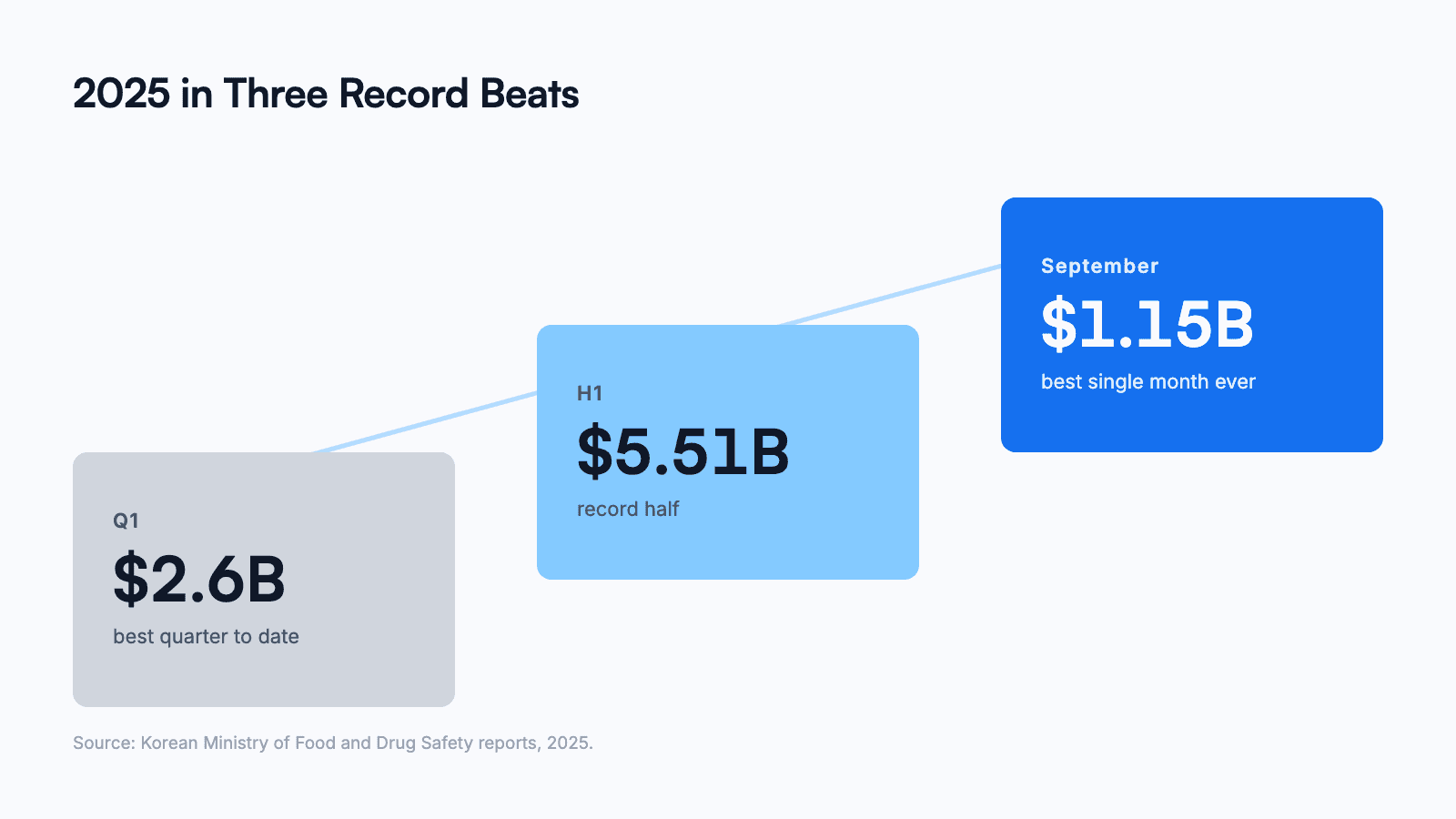
Korean cosmetics exports set a record $10.2 billion in 2024, up 20.6%, and 2025 kept raising the bar: the first half alone reached a record $5.51 billion, up 14.8%, with the second quarter setting its own record at $2.93 billion. This is no longer a China story. North America is pulling the category forward, and Korea has already overtaken France as the top source of American cosmetics imports.
Canada adds a tailwind of its own. Since the tariff dispute with Washington began in February 2025, roughly 4 in 5 Canadians have shifted at least some spending away from American products. Korean skincare sits comfortably on the right side of that mood: it is not American, it enters the country duty free, and shoppers already know it from their feeds.
Demand, in other words, is settled. The real question for a Canadian store is whether the margin survives the journey from Seoul to your shelf.
Insight: September 2025 was the biggest single month in Korean cosmetics export history at about $1.15 billion, up roughly 26% year over year.
—
Sephora and Ulta Did Your Homework for You
When the continent’s biggest beauty retailers commit shelf space, they have already run the demand math. In 2025 they committed hard.
Sephora
Biodance launched at Sephora in February 2025, and Beauty of Joseon, Torriden, Aestura, and Hanyul followed through the year.
Ulta
Anua reached Ulta shelves in February 2025, the K Beauty World platform went nationwide in July, and the chain added 13 Korean brands over the summer, including TirTir, Mixsoon, and Fwee. We unpacked what Ulta’s Korean beauty push signals earlier this year, and the short version still holds: when mass retail commits permanent fixtures instead of seasonal endcaps, it is reading repurchase data, not chasing a fad.
For an independent Canadian retailer, that expansion is validation, not competition. The chains educate shoppers on the category; specialty stores, pharmacies, and grocers win on curation, service, and the brands the giants have not stocked yet. The 2025 retail map even cleared room: with Hudson’s Bay closing its final stores by June 1, a large pool of Canadian beauty spend went looking for a new counter this year, and specialty shelves are among the places catching it.
—
Where the Margin Leaks: Direct Import versus Domestic Wholesale
Korean skincare carries healthy wholesale economics: accessible cost prices, strong perceived value, and retail price points shoppers accept without discounting. So the profit question is really a buying question, and the first term worth defining is landed cost: everything it takes to get a sellable, compliant unit onto Canadian soil, not just the factory invoice. A store importing directly picks up cost lines that quietly eat the margin:
Freight on small volumes: ocean rates from Busan only make sense at pallet scale; small orders end up on air freight at several times the cost per unit.
Compliance: every product needs a Health Canada cosmetic notification and fully bilingual labelling. Spread across a large portfolio the cost is trivial; paid per product on a twelve SKU test order, it is not.
Brokerage and clearance: customs brokers charge fixed fees that hit a small shipment exactly as hard as a container.
Cash tied up: factory minimums, long production and sailing times, and currency swings between won and dollars mean money sleeps on the water instead of turning on your shelf.
Buying domestic wholesale collapses those lines into one landed price. The trade backdrop helps too: Korean cosmetics enter Canada duty free under a free trade agreement in force since 2015, while American buyers have absorbed a 15% tariff on Korean goods since August 2025, a rate their two governments finalized at the end of October. On this category, a Canadian shelf now enjoys structurally better import economics than an American one.
One caution while you compare quotes: a price that undercuts every legitimate distributor usually means grey market stock with no notification, no bilingual label, and no recourse when a batch is questioned. We walked through the real cost of grey market Korean cosmetics last month; the short version is that the discount is borrowed, not earned.
Key takeaway: Demand rarely decides whether Korean skincare is profitable in Canada. The cost lines do: freight, brokerage, labelling, and cash tied up in minimums that domestic wholesale removes.
—
A 90 Day Test That Answers the Question for Your Store
National export records will not tell you how the category performs at your till. A structured test will, and it does not require a large bet. Here is the framework we walk first time buyers through:
Start tight: twelve to twenty SKUs across two or three brands beats forty SKUs across ten. Anchor with a recognizable hero, a Skin1004 centella line for example, then add a treatment story like Numbuzin numbered serums and a single ingredient specialist like Mixsoon.
Ladder the prices: one approachable entry point, a core serum or cream in the middle, and one premium hero. The ladder lets a curious shopper start small and trade up on the second visit.
Give it real estate and a story: a dedicated K beauty section with simple ingredient signage outsells the same products scattered through general skincare. Routine placement, cleanser to essence to serum to cream, does the explaining for you.
Check sell through at week six: sell through is simply units sold divided by units received. Reorder the winners, swap the laggards, and let the data pick your spring assortment.
Proof that the patient version works sits in grocery aisles today: Eqqualberry, one of the 17 Korean brands we distribute, grew into eight H Mart locations across Metro Vancouver and Alberta by earning reorders store by store, not by launching everywhere at once. And because our wholesale catalogue runs to about 390 catalogued products, widening a winning test never requires finding a second supplier.
—
So, Is Selling Korean Skincare Profitable in Canada?
Yes, when the buying is structured right. The 2025 record run gives you the demand case for any 2026 planning meeting; domestic wholesale protects the margin that makes the category worth carrying. The questions we hear most from buyers, answered straight:
What margin should I expect on Korean skincare?
Beauty retail convention is keystone, a 50% gross margin, and carefully bought Korean lines routinely support keystone plus because wholesale costs sit below comparable western prestige products. Your exact number depends on brand, format, and volume; our margin math guide walks through the full calculation.
How much do I need to invest to get started?
Less than most buyers assume. Working with a domestic distributor means no factory minimums to meet, no ocean freight to book, and no compliance bill before the first unit sells; those costs are already absorbed across a warehoused portfolio.
Is the category still growing, or did I miss it?
Exports set a record in 2024, then kept breaking records through 2025, and the biggest single month ever recorded was September. Chains committing permanent shelf space is a signal of repurchase, and repurchase is what makes a shelf profitable long term.
Is December too late to plan for 2026?
It is the right time. Confirm an assortment now and cleared domestic stock arrives in time for the January reset and Lunar New Year gifting on February 17, with no ocean transit in the calendar.
As a Vancouver based Canadian distributor, we handle regulatory intake, labelling, import clearance, and warehousing before a price sheet ever reaches you, and we support launches with localized marketing and influencer campaigns once stock is on your shelf. Selling Korean skincare profitably in Canada is not a bet on a trend; it is a buying decision made properly.
Ready to build your 2026 K beauty assortment?
Let’s talk.
Glimbora Insights